

Whether it's a tabletop army, a fantasy character model or an intricate diorama – when it comes to painting, the lighting determines the result. The wrong light distorts colours, casts distracting shadows and tires your eyes. This guide shows what really matters when it comes to colour temperature and magnification – and how to find the right magnifier lamp for your hobby desk.
Why ordinary room lighting fails when painting
A standard living-room lamp is unsuitable for precision work – for three reasons:
- Colour distortion: Warm-white light (2700–3000 K) casts a yellow tint over every colour. A carefully mixed skin tone or a subtle glaze suddenly looks completely different. Reliable colour assessment becomes impossible.
- Shadow casting: A single, distant light source creates hard shadows – right where your hand and brush obscure the fine details.
- Eye fatigue: Too little, flickering light forces your eyes to work non-stop. After an hour of edge highlighting, you'll really feel it.
A good magnifier lamp solves all three problems at once: colour-accurate daylight, shadow-free illumination right at the workpiece and magnification for the finest details – without having to hunch over the model.
The two decisive factors: colour temperature and magnification
1. Colour temperature & colour rendering
For colour-accurate work you need neutral-white daylight in the range of 5.500–6.500 Kelvin. It comes closest to midday light and shows colours as they really are – crucial when you're mixing tones, building up shading or want to colour-match across several sessions.
At least as important is the colour rendering index (CRI or Ra). For modelling the rule is: Ra ≥ 80 is a must, Ra ≥ 90 is ideal, and higher is even better. Only then can you reliably distinguish subtle transitions between similar colour tones.
2. Magnification – which dioptre value?
The magnification of a magnifier lamp is given in dioptres (dpt). The higher the value, the stronger the magnification – but the closer you have to get and the smaller the visible field becomes.
| Dioptres | Magnification | Ideal for |
|---|---|---|
| 3 dpt | approx. 1,75-fach | Priming, basing, an overview of the whole model, a large field of view |
| 5 dpt | approx. 2,25-fach | The all-round value for painting: layering, washes, edge highlights and fine details |
| 8 dpt | approx. 3-fach | The finest details: eyes, NMM effects, freehand ornamentation and very fine lines |
The Lumeno models 851X and 861X are available with either 3 or 5 dioptres; for most painting and detail work, 5 dpt is the recommended choice. If you want to set even finer accents, the 127-mm models also offer the glass lens with 8 dioptres.
Stand instead of clamp: why a base makes more sense at the hobby desk
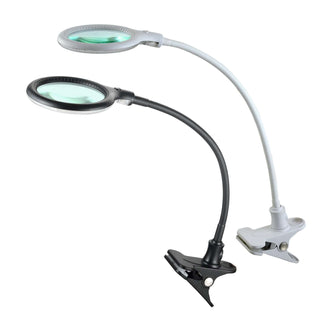
Many magnifier lamps are offered with a table clamp. At the hobby desk that's often the poorer choice: clamps need a suitable, free table edge and fail on thick tops or setups with a back panel. What's more, the arm is fixed in place – changing spots means first loosening, then re-clamping.
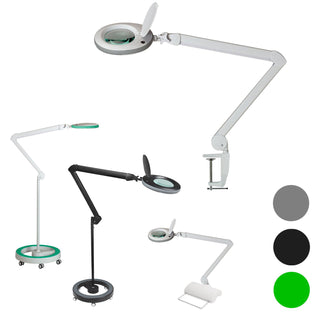
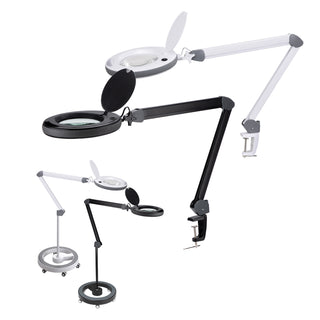
A magnifier lamp with a base you simply place wherever you need it, swivel the arm flexibly over your model and move it aside when required. No clamping problem, no restriction from the table shape – especially when your painting desk is also used for other work.
Adjusting magnification: interchangeable lenses on the Lumeno models
You're not locked into a single magnification. On the 127-mm models the lens can be switched between 3, 5 and 8 dioptres; the 851X and 861X offer switching between 3 and 5 dioptres. Suitable replacement lenses:
- 127-mm glass lens in 3, 5 or 8 dpt (for the 127-mm models)
- Replacement lens 152 mm for the 851X (3 or 5 dpt)
- Oval replacement lens for the 861X (3 or 5 dpt)
To be honest: the lens change is intended as a flexible upgrade, not as a quick swap every few seconds. To do it, you unscrew the ring on the lamp head and replace the lens – ideal for reconfiguring between projects, not for constant switching during a single painting session.
What to look for when buying
- Light colour: neutral-white daylight (5.500–6.500 K)
- Colour rendering: CRI/Ra ideally ≥ 90, higher is even better
- Dioptres: 5 dpt as the all-round value, up to 8 dpt for the finest details
- Lens size: a large lens = more overview and more relaxed working
- Mounting: a base for flexible use at the hobby desk
- Dimmability: brightness adjustable to time of day and material
- Flicker-free: gentle on the eyes during long sessions
Recommended Lumeno models for scale models & miniatures
For demanding painting and craft work, we recommend these magnifier lamps with colour-accurate daylight and an interchangeable lens:
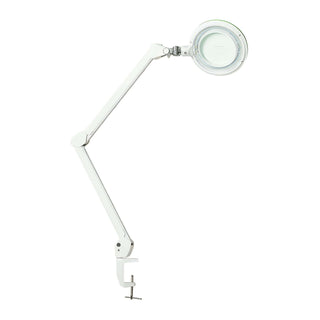
- Lumeno 851X with 152 mm real glass lens, dimmable – large round all-rounder with a wide field of view
- Lumeno 861XGR with oval lens – wide field of view thanks to the oval lens shape
→ View all Lumeno magnifier lamps
Frequently asked questions
Which lamp is suitable for painting miniatures?
Ideal is a magnifier lamp with neutral-white daylight (5.500–6.500 K), a high colour rendering index (Ra ≥ 90) and a magnification of around 5 dioptres. It delivers colour-accurate, shadow-free light right at the model and magnifies fine details without you having to hunch over the workpiece.
Which colour temperature do I need for colour-accurate painting?
Neutral-white daylight between 5.500 and 6.500 Kelvin. Warm-white light (2700–3000 K) creates a yellow tint and distorts every colour – a reliable colour assessment is not possible with it.
How strong does the magnification need to be for tabletop miniatures?
For most work, 5 dioptres (approx. 2,25-fach) are the best choice. For the finest details such as eyes or NMM effects, some models also offer 8 dioptres (approx. 3-fach). 3 dioptres (approx. 1,75-fach) give more overview and a larger field of view.
Magnifier lamp or desktop magnifier – which is better for modelling?
A magnifier lamp combines magnification and shadow-free lighting in a single device. A plain desktop magnifier without light has to be lit separately and quickly creates distracting shadows. For painting and craft work, the illuminated magnifier lamp is clearly the better option.

0 comments